
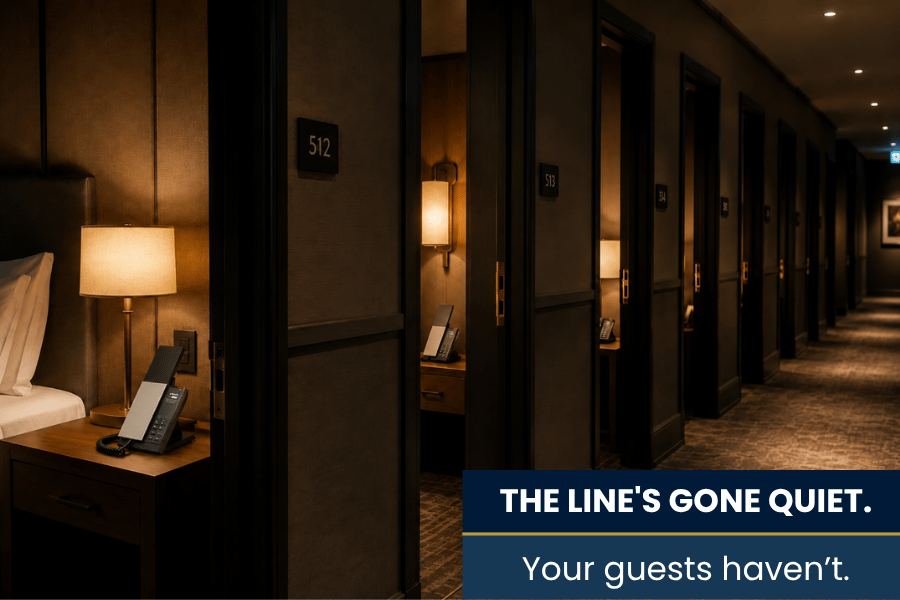
Walk into most GM offices and ask about guest room phones, and you’ll hear some version of the same story: external call volumes have collapsed, revenue from phone use is a fraction of what it used to be, and the room phone is on its way out. The numbers behind that story are real. What’s less certain is whether they’re answering the right question.
The numbers behind the assumption
Nobody’s disputing that external calling has fallen off a cliff. Based on our own research across Australian hotels, external guest calls now add up to less than 30 minutes per month. The simplest explanation is also the most obvious one: guests have an option they never used to have.
A couple of decades ago, calling home from a hotel room meant using the room phone, because there wasn’t really an alternative. Now guests arrive with their own phone, their own contacts already saved, and their own plan or app already set up. Given the choice between fumbling for a hotel directory and pressing a name already sitting in their pocket, most guests will choose the one that’s already right there.
Hotel operators have watched this play out first-hand. Radisson Hotel Group’s Chief Information Officer has pointed to a clear decline in guest room phone usage, noting that today’s guests typically check in carrying mobile devices of their own. This leaves the in-room phone well down the list of what they actually reach for.
None of that’s in question. Where it gets more complicated is what hotels conclude from it.

But that’s only half the picture
External calling and guest communication aren’t the same thing, and treating a decline in one as a decline in the other misses what’s actually happening inside your property. Our research uncovered a different story once internal communication was measured on its own. In Australian city-based hotels are averaging 1000 minutes of internal calls per 100 rooms per month. So a 200-room hotel would see roughly 2,000 minutes of internal calls from guests per month. (Resort properties, by comparison, see close to double that call volume).
As an example, a Brisbane property with less than 300 rooms is logging over 4,100 minutes of internal guest communication every month. When occupancy is factored in, this works out to close to 18 minutes of guest interaction for every occupied room per month. Requests for towels, questions about the air conditioning or TV not working, room service orders, calls at odd hours when nobody wants to dig through an app. Thousands of service moments a year, running through a channel plenty of operators had all but written off.
External calls fell because guests stopped calling home from the room. That’s not the same as guests no longer needing to talk to your team and order services.
Why external call volume is the wrong metric
Here’s the trap: it’s tempting to judge the health of guest communication by looking at external call logs, because that’s the number that’s easiest to pull and the one that’s dropped the most dramatically. But that’s a bit like judging a restaurant by how many takeaway orders it does. It tells you something, just not the thing that actually matters.
The more useful question isn’t how many calls left the building.
External call volume only tells you who stopped calling out. It says nothing about who’s still asking for help inside the hotel, and that number hasn’t dropped at all.
External call logs count the guests who reached out to somewhere else. They miss the ones reaching out to reception, housekeeping, and maintenance every single day. These are the requests that never touch an external call log. That’s where the real service experience actually lives, in all the moments a call report was never built to capture. Judged against that fuller picture, plenty of hotels that assume their room phones have gone quiet would find the opposite is true.
What hotels should be asking instead
The real question was never whether guests still need a phone beside the bed. It’s whether every guest can reach the hotel easily whenever they need help. Guests don’t think in terms of channels. They think in terms of convenience, and what counts as convenient has more to do with the situation than with who’s asking.
A guest landing after a long flight and wanting something sorted immediately will often just pick up the phone rather than open an app. So will a guest who already knows exactly what they want, a burger, not a browse through the room service menu. A guest happy to graze and see what looks good might prefer to scroll through the app instead, and someone half-asleep at 2 am almost certainly isn’t opening either.
None of those preferences are wrong, and none of them show up in an external call report.
This matters for how communications decisions actually get made. A hotel that reads falling external call volumes as falling demand risks retiring infrastructure that’s still doing real work, or worse, replacing it with something that looks more modern but makes it harder for exactly the guests who relied on the phone to get help quickly.
The decision isn’t analogue versus SIP versus digital-only solutions such as QR codes. It’s understanding what guests in your specific property are actually asking for, and making sure whichever channel they choose gets them the same standard of response.
The bottom line
External call volumes tell a real story, just not the whole one. They explain why phone revenue has disappeared, not whether guests can still reach your hotel when they need to, and they say nothing about the thousands of internal requests happening every month regardless of what that log shows. Before deciding what to do with your guest room phones, it’s worth checking which question you’re actually answering, because that answer will look different at every property.
This article isn’t meant to convince you that room phones are either essential or obsolete, so much as prompt that question. If it’s done that, it’s done its job.

Whether you’re planning a refurbishment, reviewing your communications infrastructure, or just want an independent read on where guest room phones stand at your property, the team at Technology 4 Hotels would be glad to talk it through. Our role isn’t selling a particular platform, but helping you make sense of your own data and decide with confidence, whether that means changing something or confirming what’s already in place. The best technology decisions rarely start with a sales presentation. They start with a conversation, so get in touch if you’d like to dig into what your own numbers are saying.
If you have feedback on this article or would like to connect, please get in touch via phone +61 2 8317 4000, or book a time for a complimentary 15-minute Tech Chat, just click here.
Frequently Asked Questions
A: Guest room phones lost ground once mobile phones took hold from around 2007 onwards, followed soon after by internet-based calling. It’s also fair to say that external call rates at many hotels were quite pricey, which made a guest’s own phone an even easier choice.
A: Yes, just for a different reason. Guests have largely stopped using room phones to call outside the hotel, but many still use them to contact reception, housekeeping or maintenance from within the property, particularly late at night or when a fast, reliable response matters.
A: No. External call volume only measures calls leaving the hotel. It says nothing about internal requests, guest messages or app-based communication happening between guests and staff, which can stay high even as external calling falls close to zero.
A: Not on that basis alone. External call data doesn’t capture whether guests can still reach the hotel easily when they need help. Any decision about guest room phones should be based on a property’s actual guest communication patterns, not a single declining metric.
A: A more useful measure is how effectively the hotel communicates with guests already on the property: response times, internal request volume, and whether every channel a guest might choose leads to the same standard of service.